
The process wall
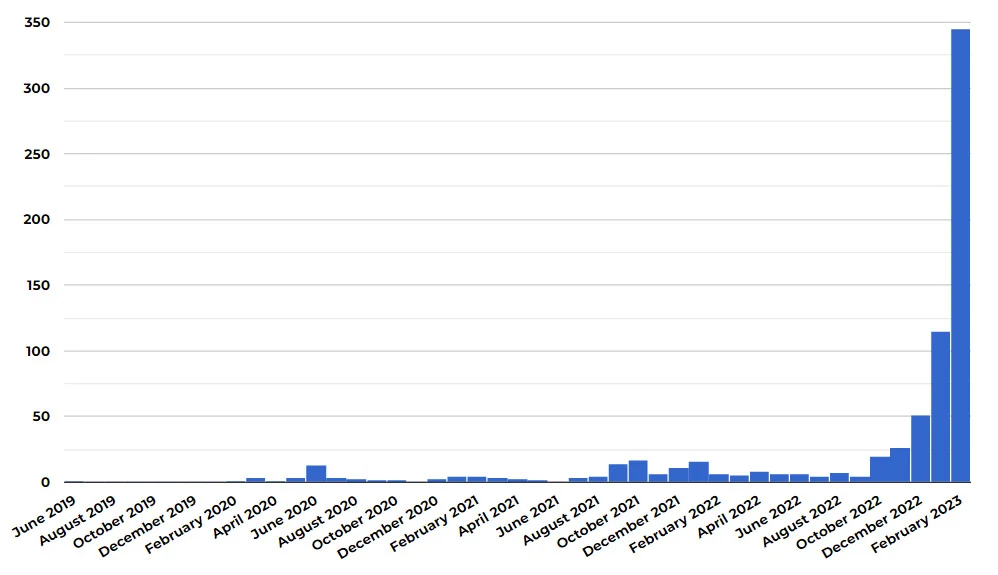
Clarkesworld reads short fiction through an open slush pile, the standard route for a science-fiction magazine to find new writers. In a 15 February 2023 post, editor Neil Clarke described a wall forming in that pipeline: submissions he judged to be generated rather than written had gone from ‘below 20’ a month for years to ‘over 100 in January, and nearly 350 so far in February 2023,’ on his own tracking.
What the documents show
Clarke's post gives a specific trajectory in his own numbers: about 25 spam submissions in November 2022, 50 in December, then the January and February spikes above, with spam accounting for ‘38% this month’ of the bans he issued. He closed submissions on 20 February after the volume spiked again that morning, ‘over 50 before noon.’ The magazine's current submissions page, as retrieved, sets the resulting policy: fiction submissions ‘translated, written, developed, or assisted by these tools’ will not be considered and may lead to a ban; non-fiction and art carry the same restriction; and, addressing a separate worry, any submitted work ‘will not be used to train “AI” tools of any kind.’
Authorship and limitation
The mechanism at stake is trust in a slush pile, not literary judgment about machine-written prose. An editor reading unsolicited fiction has always relied on the assumption that a submission represents a specific person's effort; at volumes machines make possible, that assumption breaks before any single story is read closely. Clarke's post acknowledges detection is imperfect rather than claiming a reliable filter, which is precisely why the fix was a submission-terms ban rather than a promise to catch every instance. A ban and a detector are different tools: one is a contractual condition a submitter agrees to, the other is a technical claim about spotting machine text, and the magazine chose the former.
What survives
For a writer today, the policy answers more than one question at once: it bars submissions produced or substantially assisted by generative tools, and separately withholds all submitted work, accepted or not, from being used to train such tools — a protection for the slush pile's contents regardless of the AI-writing question. Other markets set their own lines, so a writer should not assume Clarkesworld's terms transfer elsewhere.
- Read a market's current submission guidelines before assuming an AI drafting or brainstorming tool is compatible with it.
- Note the distinction between a ban on AI-assisted writing and a separate promise not to use submissions for AI training.
- Check whether a magazine's policy also covers non-fiction and art, since restrictions can differ by category.
The closure was a short-term response to a volume spike the editor documented in his own numbers; the standing policy that followed addresses both the writing question and the training question separately, and neither should be read as a claim that detection itself is solved.
Sources & reading trail
Editor's own account of submission-spam volume by month and the 20 February closure of submissions.
Source published: 15 February 2023 · Retrieved: 16 September 2026
States the current policy barring AI-assisted submissions and excluding submitted work from AI training.
Source published: Not established · Retrieved: 16 September 2026
Papers, documentation, rulings and the makers' own records establish the note; the authorship reading and what-survives are Creative AI editorial analysis. This retrospective draft does not imply the site published on the event date.