The process wall
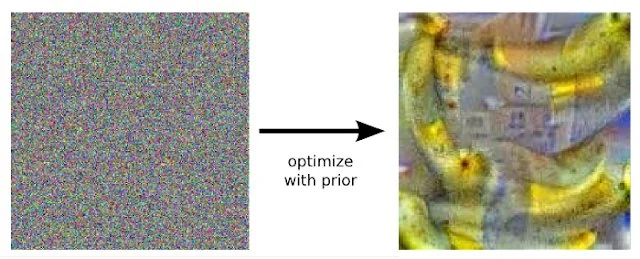
On 18 June 2015, three Google engineers, Alexander Mordvintsev, Christopher Olah and Mike Tyka, published a post describing a technique for looking inside an image classifier rather than for making pictures. The post explains a method the authors call turning the network 'upside down': instead of asking what class an image belongs to, the technique starts from noise or an existing image and uses gradient ascent to amplify whatever pattern a chosen layer already responds to. The wall it addressed was interpretability — verifying that a network had 'correctly learned the right features' rather than an accidental shortcut.
What the documents show
The post reports that this diagnostic use produced an unplanned discovery: a classifier trained to recognise dumbbells generated images of dumbbells attached to a 'muscular weightlifter', revealing the network had learned an association with the object's typical context rather than the object alone. Pushed further across layers, the same procedure produced pareidolia-like hybrids the authors nicknamed 'Dog-Fish' and 'Pig-Snail'. The accompanying code repository, later archived, published the notebook implementing the technique and invited others to run it, without describing it as a finished creative tool. A licensing update added to the post on 13 July 2015 states the images in it are licensed by Google under a Creative Commons Attribution 4.0 licence, with one stated exception: images built from places sourced from the MIT Computer Science and Artificial Intelligence Laboratory required separate permission from MIT.
Authorship and limitation
The mechanism worth naming is gradient ascent on an existing model's activations, not generation from a learned distribution the way a GAN or diffusion model works. DeepDream does not compose an image from nothing; it exaggerates patterns a specific pretrained network already associates with a specific class, which is why its output looks unmistakably tied to whichever classifier produced it. The technique cannot target an intention the network has no concept for, and it cannot explain why a given layer responds the way it does — it can only show the response, amplified. Recognising a diagnostic tool becoming an aesthetic on release is itself worth stating as a limitation: the images are evidence about a classifier's learned features, not a settled claim about what the network 'sees' or 'wants'.
What survives
Editorially, DeepDream is worth keeping distinct from later generative tools precisely because it was not built to generate: it is a debugging technique that revealed how much of a network's internal representation could be surfaced visually, and that discovery, not a creative-tool release, is what the primary sources document.
- Read the post's dumbbell example and identify what it shows about training-data context.
- Compare the archived repository's stated purpose with how the resulting images circulated publicly afterwards.
- Ask whether a given visual effect is diagnostic amplification of an existing model or generation from a trained distribution.
The repository was archived in December 2023, closing further changes to the original code while leaving the 2015 post as the primary record of what the authors said they had built and why.
Sources & reading trail
Describes the gradient-ascent technique, the dumbbell/weightlifter and animal-hybrid examples, and a 13 July 2015 update licensing the post's images under Creative Commons Attribution 4.0 with a stated MIT exception.
Source published: 18 June 2015 · Retrieved: 16 September 2026
Confirms the repository published the notebook implementing the technique and shows it was archived on 22 December 2023.
Source published: Not established · Retrieved: 16 September 2026
Papers, documentation, rulings and the makers' own records establish the note; the authorship reading and what-survives are Creative AI editorial analysis. This retrospective draft does not imply the site published on the event date.