The process wall
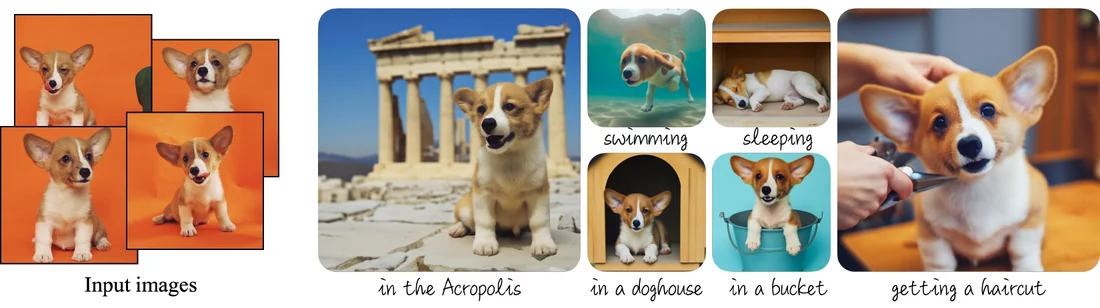
Google and Boston University researchers posted the DreamBooth paper to arXiv on 25 August 2022, describing a way to fine-tune 'a pretrained text-to-image diffusion model' on 'just 3-5 images of a subject' so that the model learns to place that specific subject, a person, a pet, an object, into new scenes on request. For a working process built around a handful of reference photographs, the change is that those few images become training data for a personal, reusable model rather than a static reference held up beside a canvas.
What the documents show
The paper's method binds 'a unique identifier' to the subject during fine-tuning and adds 'a new autogenous class-specific prior preservation loss' so the model does not forget the general category the subject belongs to while learning the specific instance. The accompanying project page demonstrates the resulting range: subject recontextualization, placing an object in new settings; text-guided view synthesis, generating unfamiliar angles of it; and artistic rendering, repainting it in a named style. Under a 'Societal Impact' heading, the same page states the intended use plainly, 'an effective tool for synthesizing personal subjects... in different contexts,' and pairs that with an explicit risk: 'malicious parties might try to use such images to mislead viewers,' which it calls 'a common issue' shared with other generative and manipulation techniques rather than one unique to this method.
Authorship and limitation
The mechanism to name plainly is identifier binding on a small personal dataset, not memorisation of a large scraped corpus: DreamBooth's training set is the handful of photographs a user supplies, so the likeness question it raises is closer to a photographer's own consent to be trained on than to a dataset-scale scraping dispute. That makes consent for a specific person's likeness the live authorship question, not training-data provenance at scale, since the subject is knowingly and deliberately supplied by whoever runs the fine-tuning. The paper's own prior-preservation mechanism is about preserving the model's general category knowledge, not about verifying that the fine-tuning subject consented to appear in new, generated contexts, a question the paper does not claim to answer.
What survives
Editorially, what a maker keeps from this record is the paper's own acknowledgement that the risk is real and unresolved, stated as an area needing 'continued investigating and revalidating' rather than a solved problem. A likeness fine-tuned this way should carry the same consent check a photographer would apply before publishing reference photographs of a named person in new, fabricated situations.
- Read the Societal Impact section against a specific tool's own consent or likeness policy before fine-tuning on a real person.
- Check whether a given DreamBooth-based tool asks for the subject's permission before training.
- Compare the paper's small-dataset method against a style LoRA's larger, often unconsented dataset before treating the two risks as identical.
DreamBooth's own documents describe a precise, small-scale technique and, in the same breath, a risk they say the field has not closed, a more honest starting point for a maker than either enthusiasm or alarm on its own.
Sources & reading trail
States the method: few-image fine-tuning, unique identifier binding, and the class-specific prior preservation loss.
Source published: 25 August 2022 · Retrieved: 16 September 2026
Demonstrates use cases and states the Societal Impact section's stated misuse risk.
Source published: Not established · Retrieved: 16 September 2026
Papers, documentation, rulings and the makers' own records establish the note; the authorship reading and what-survives are Creative AI editorial analysis. This retrospective draft does not imply the site published on the event date.