
The process wall
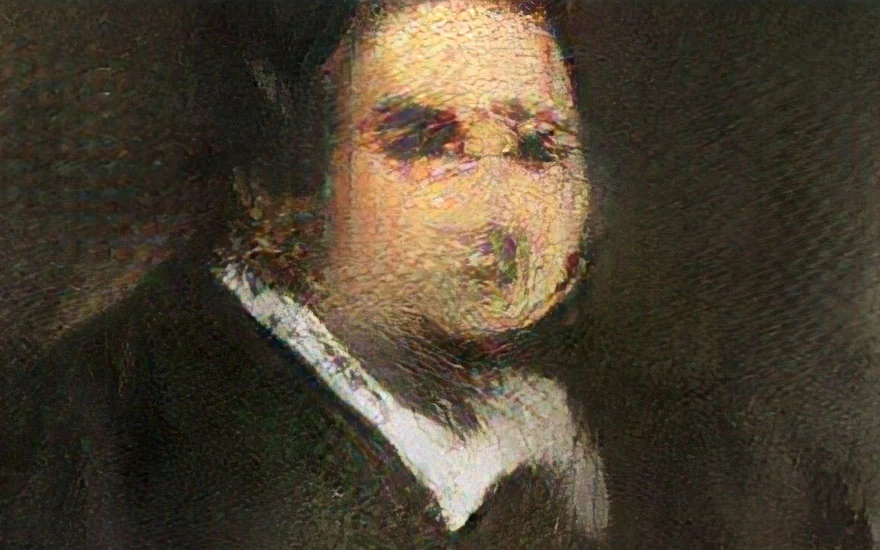
On 25 October 2018, Christie's sold a canvas titled 'Edmond de Belamy, from La Famille de Belamy' as part of a three-day Prints & Multiples sale in New York. The lot record describes it as a 'generative Adversarial Network print, on canvas, 2018, signed with GAN model loss function in ink by the publisher, from a series of eleven unique images, published by Obvious Art, Paris'. The house had catalogued it with an estimate of $7,000 to $10,000; the wall the sale then hit was less about the algorithm than about what happened to that estimate once bidding started.
What the documents show
The lot record states the final price as $432,500. In an article Christie's published in December 2018, Obvious member Hugo Caselles-Dupré describes the algorithm as composed of two parts, 'the Generator' and 'the Discriminator', trained on 'a data set of 15,000 portraits painted between the 14th century to the 20th'. Contemporaneous reporting adds detail the sale listing does not: an article published by The Verge on 23 October 2018 reports that Obvious built the portrait using code substantially drawn from Robbie Barrat, a programmer who had shared his GAN scripts on GitHub under an open-source licence, and quotes Caselles-Dupré acknowledging as much: 'If you're just talking about the code, then there is not a big percentage that has been modified.'
Authorship and limitation
The mechanism worth separating here is code authorship from artwork authorship, and the lot record itself gestures at the distinction: it names 'the publisher' as the signatory, via a segment of the algorithm's loss function, not a named individual. Barrat's contemporaneous statement, that he was 'more concerned about the fact that actual artists using AI are being deprived of the spotlight', is a party statement about credit, not a legal finding — no court record establishes wrongdoing, and Barrat is reported as having shared the code under an open licence that permitted this kind of reuse. What the auction priced was a framed, signed print attributed to Obvious as publisher; what stayed contested, on the parties' own contemporaneous statements, was how much of the underlying method was theirs to begin with.
What survives
Editorially, this sale is a template for a question worth asking of any credited 'AI artist': how much of the described method was written by the credited party, how much was adapted from elsewhere, and does the credit line say which is which. The lot record's own phrase, 'signed with GAN model loss function', is a rare case of an auction house's paperwork naming the mechanism rather than only the output.
- Read the lot record's stated medium description against the sale's estimate and final price.
- Compare Caselles-Dupré's and Barrat's contemporaneous quotes on how much of the code changed.
- Ask whether a work credited to a 'publisher' or 'collective' names the individual authors of its underlying method.
The estimate-to-price gap — roughly sixty times the top estimate — is itself a documented fact of the lot record, not an interpretation; what caused it is a separate question the same record does not answer.
Sources & reading trail
States the medium description and publisher credit, the USD 7,000-10,000 estimate and the USD 432,500 price realised.
Source published: Not established · Retrieved: 16 September 2026
Quotes Hugo Caselles-Dupre describing the Generator/Discriminator structure and a training set of 15,000 portraits from the 14th to 20th centuries.
Source published: 12 December 2018 · Retrieved: 16 September 2026
Reputable original reporting: reports the code was substantially drawn from Robbie Barrat's openly shared GAN scripts and quotes both Caselles-Dupre and Barrat on the resulting credit dispute.
Source published: 23 October 2018 · Retrieved: 16 September 2026
Papers, documentation, rulings and the makers' own records establish the note; the authorship reading and what-survives are Creative AI editorial analysis. This retrospective draft does not imply the site published on the event date.