The process wall
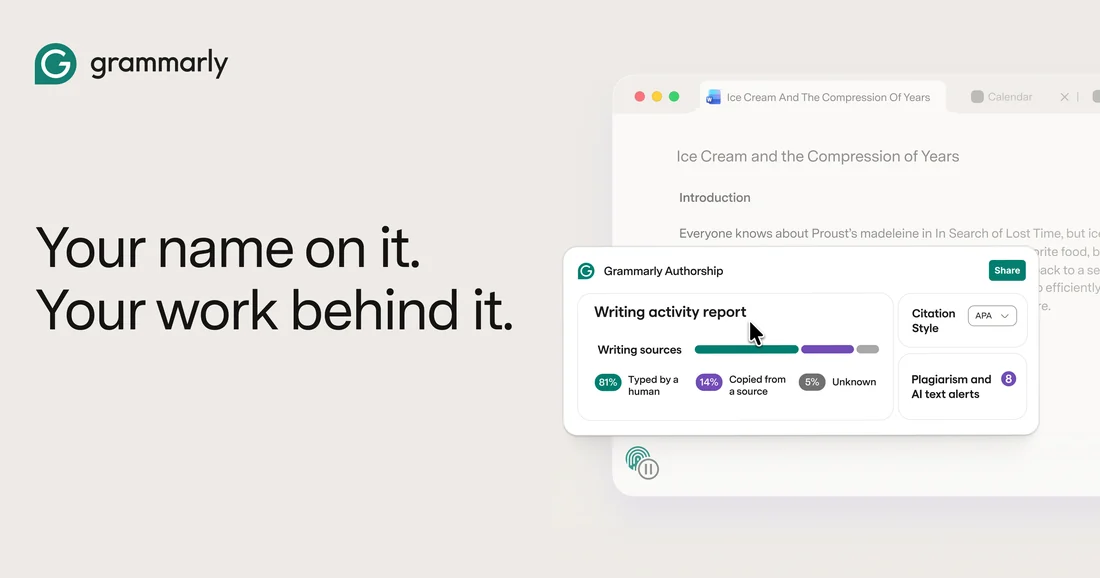
A finished document erases the process that produced it: a reader cannot tell typed from pasted from generated once a file is submitted. Grammarly's Authorship feature, as retrieved on 16 September 2026, moves the record earlier, into the drafting step itself. The product page states it ‘monitors typed, pasted, AI-assisted’ content and ‘records your actual writing process,’ rather than analysing only a completed draft.
What the documents show
The feature produces a shareable ‘Authorship Report’ that, per the page, ‘color-codes your entire assignment to show each sentence's source,’ with a summary graph and a replay of the document's construction; the vendor's own framing against detection software is explicit: ‘AI detectors only guess from the final draft. Authorship records your actual writing process.’ A linked support article details what is captured — text ‘typed directly into your document,’ text ‘pasted from a browser-based source’ with the source recorded, text from ‘an unknown source, such as a private browsing window,’ and ‘your prompts to generative AI’ — and states the data is encrypted on-device and ‘retained … for up to 10 years’ once a report is generated.
Authorship and limitation
The mechanism to name plainly: a process record shows an input channel, not composition quality, and it is not infallible even on its own terms. The support article states the tool ‘may not capture 100% of cases accurately’ — keystrokes ‘typed too fast’ can be missed, text pasted from a desktop source is unattributed ‘where Authorship does not run,’ and in Microsoft Word specifically ‘a 20-page limit’ applies because ‘tracked history may become unreliable’ beyond it. Without clipboard permission granted, the system ‘will only track text actions within the current’ document and cannot identify where pasted text came from. A report is therefore evidence of a recorded process within stated bounds, not a ledger that closes every gap a determined user could exploit.
What survives
Before relying on a report to demonstrate authorship, a writer or a reader of one should check which platform — Google Docs, Microsoft Word, or the Grammarly Editor — covered the whole session, whether a Word document crossed the 20-page reliability threshold, and whether clipboard access was granted throughout. Editorially, a report that shows a process is not the same thing as an institution's own finding of originality, and should be read as one input to that judgment rather than a substitute for it.
- Confirm which supported platform and page limits applied for the whole document before treating a report as complete.
- Check that clipboard permission was active throughout if attribution of pasted-text sources matters.
- Weigh the ten-year retention period against your own or an institution's data-handling expectations before sharing a report.
Grammarly's own documents describe what the feature records and where it can fail, and both halves matter equally to anyone treating a report as proof rather than as one dated account of a drafting session.
Sources & reading trail
Describes the feature, the Authorship Report, and its stated purpose against AI-detection tools.
Source published: Not established · Retrieved: 16 September 2026
States what text categories are recorded, encryption and retention practice, and stated tracking limitations.
Source published: Not established · Retrieved: 16 September 2026
Papers, documentation, rulings and the makers' own records establish the note; the authorship reading and what-survives are Creative AI editorial analysis. This retrospective draft does not imply the site published on the event date.