The process wall
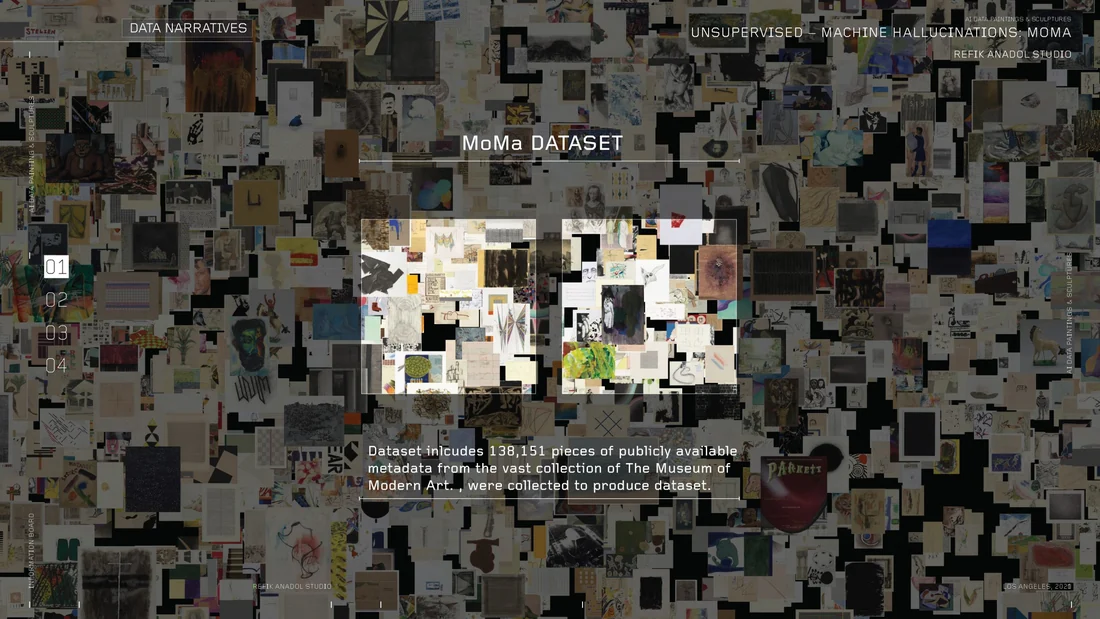
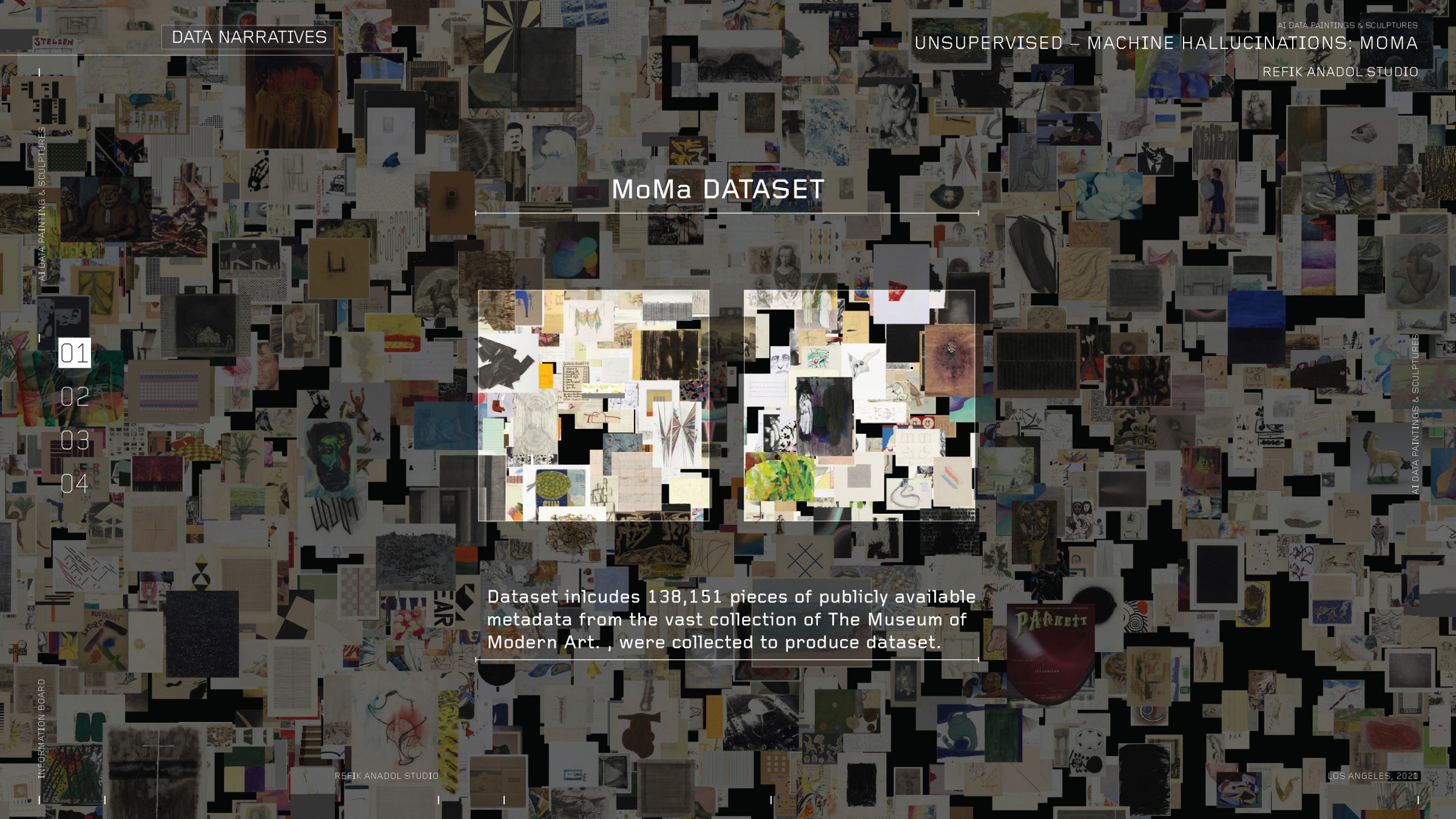
On 19 November 2022, the Museum of Modern Art opened an installation by Refik Anadol Studio built from the museum's own collection rather than from an open web dataset. According to the studio's own account of the work, titled 'Unsupervised', the piece 'processes 138,151 images from MoMA's collection in the mind of a machine' and renders the result as a continuously changing wall of moving colour and form. The wall Anadol worked against was not computing power but a curatorial one: how to turn a machine's internal representation of a collection into something a gallery audience could stand in front of.
What the documents show
The studio's account states the technique used 'StyleGAN2 with adaptive discriminator augmentation (ADA)', an algorithm it credits to NVIDIA researchers, and that the studio 'trained a unique AI model with subsets of the collection, creating embeddings in 1024 dimensions', navigated afterwards with a custom tool it calls the 'Latent Space Browser'. MoMA's own exhibition page describes the same project in narrower terms, stating that Anadol 'trained a sophisticated machine-learning model to interpret the publicly available data of MoMA's collection' — publicly available data, not the museum's full holdings regardless of rights status. The museum's page gives the physical run as 19 November 2022 to 15 April 2023; the studio's own site extends the project online through 29 October 2023, without the two records disagreeing on what the museum itself showed.
Authorship and limitation
The mechanism worth naming is embedding and interpolation, not curation by a machine. A model trained on a museum's images learns a compressed numerical space in which images sit near others sharing visual features; 'walking' through that space, in MoMA's own description, produces combinations no person drew, but the space's resolution and which subset populated it were the studio's choices, not the model's. Both records agree the museum supplied data described as publicly available, which leaves open, and neither answers, how that boundary was drawn against works still under copyright or loan restriction. Describing the result as the museum's collection 'dreaming' is the institution's own metaphor, not a technical claim about the model having intent.
What survives
Editorially, a maker adapting this approach for a smaller archive can check three things these documents do name: the stated scope of the training data, described here as a subset rather than everything held; the licensing or access boundary used to select it; and whether the interface shown to a viewer is described as exploration of a trained space or as new, unattributed generation.
- Compare MoMA's phrase 'publicly available data' with the studio's figure of 138,151 processed images.
- Read the studio's description of embeddings and the Latent Space Browser against a single frame of the installation's output.
- Ask, of any archive-trained generative work, which subset of a collection was used and on what access or licensing basis.
What the two records agree on, plainly, is authorship of the frame: MoMA credits the machine's output to Anadol's studio, not to the model, and to the individual artists whose works trained it not at all.
Sources & reading trail
States the work processes 138,151 images from MoMA's collection using StyleGAN2-ADA and a custom Latent Space Browser, and gives its run as 19 November 2022 to 29 October 2023.
Source published: Not established · Retrieved: 16 September 2026
States Anadol trained a model to interpret 'the publicly available data of MoMA's collection' and gives the museum's installation dates as 19 November 2022 to 15 April 2023.
Source published: Not established · Retrieved: 16 September 2026
Papers, documentation, rulings and the makers' own records establish the note; the authorship reading and what-survives are Creative AI editorial analysis. This retrospective draft does not imply the site published on the event date.