The process wall
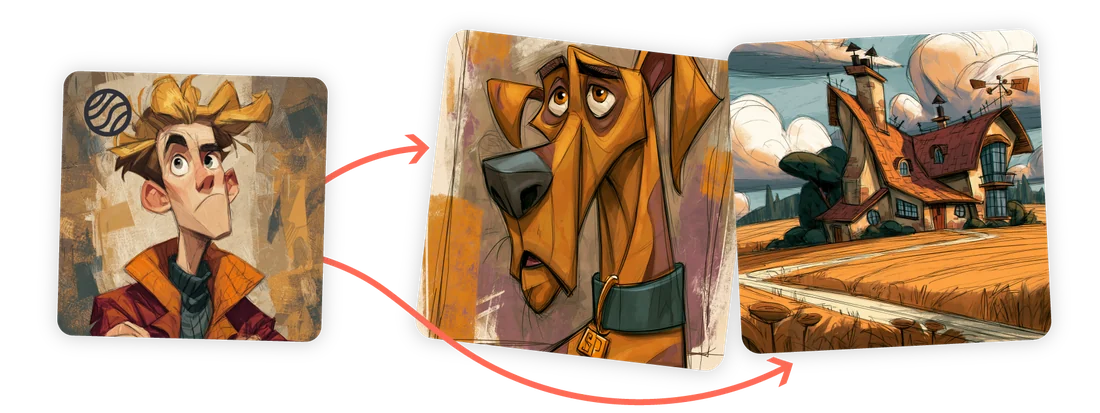
A maker picking up an image tool today is usually offered a style reference control before they are offered anything resembling a named artist's name. Midjourney's own Style Reference documentation describes the feature as a way to “capture the visual vibe of an existing image and apply it,” adding explicitly that “it doesn't copy objects or people, just the overall style — like colors, medium, textures, or lighting.” A style weight parameter controls how strongly that reference pushes the new image, and a style code lets a maker reuse a look without uploading an image at all.
What the documents show
That is the tool vendor's own description of what the control does mechanically: it biases the output toward visual qualities extracted from a reference, at an adjustable strength. That differs from what artists call mimicry; the Glaze project's own technical page answers the artist's side of that question: Glaze works by “computing a set of minimal changes to artworks, such that it appears unchanged to human eyes, but appears to AI models like a dramatically different art style,” aimed at disrupting models fine-tuned to reproduce “an individual artist's distinctive aesthetic.” Glaze's own page also states its protection is weaker against styles “already trained into base models,” and that it is “not a permanent solution.”
Authorship and limitation
The registrar's guidance supplies a third boundary, running through control rather than resemblance. The Copyright Office's guidance observes that one image-generating product describes prompts and reference material as “influencing” an output without the prompter dictating or controlling it, treating that lack of control as why such output is not human-authored. A style reference sits in exactly that gap: a maker chooses the reference and its weight, but Midjourney's own documentation does not claim the maker controls how the model interprets it — the same limitation the guidance describes for text prompts.
What survives
This is an editorial reading, not a ruling on any specific case: what separates a style reference from mimicry is not the tool feature but what it is pointed at and how it is described afterward. Referencing an aesthetic category is what the Midjourney documentation describes the tool as doing; naming a living artist as the intended target is a different, undocumented use of the same control. A maker keeps more defensible ground by keeping the reference image and describing the result as a style category, not a named individual's substituted labour.
- Check whether a style reference or style code is being described, in a brief or credit line, by aesthetic category or by a named living artist.
- Read a style-protection tool's own page for what it says it does and does not protect against, rather than assuming full coverage.
- Ask how much creative control the maker exercised over the final expression, since that is the line the registrar's guidance actually draws.
Three documents, three different boundaries: a feature description, a technical countermeasure, and a registrar's authorship test. None of them fully settle where reference ends and mimicry begins, but together they narrow the question to what is named and how much control was actually exercised.
Sources & reading trail
States the feature captures visual style, not objects or people, plus the style weight and style code mechanics.
Source published: Not established · Retrieved: 16 September 2026
Describes Glaze's cloaking mechanism against style mimicry and its stated limitations.
Source published: Not established · Retrieved: 16 September 2026
Frames prompts/references as influence without control, the basis for the human-authorship test.
Source published: 16 March 2023 · Retrieved: 16 September 2026
Papers, documentation, rulings and the makers' own records establish the note; the authorship reading and what-survives are Creative AI editorial analysis. This retrospective draft does not imply the site published on the event date.