The process wall
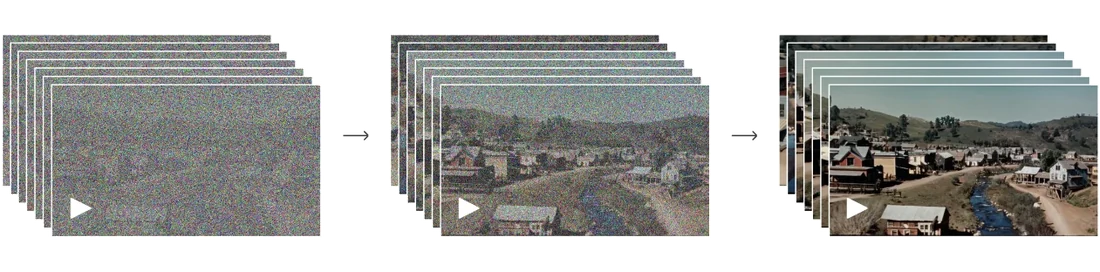
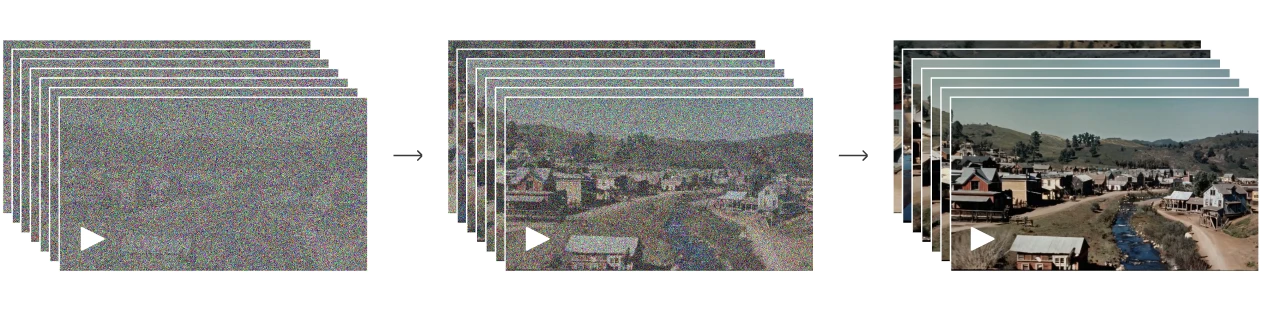
On 15 February 2024, OpenAI published a technical report rather than a shipped tool. It describes training text-conditional diffusion models jointly on videos and images treated as 'spacetime patches,' and states that the resulting model, Sora, 'is capable of generating a minute of high fidelity video.' For a maker, that report described a research capability, not a workflow: no interface, no per-second cost, no way to iterate on a shot beyond the report's own selected examples.
What the documents show
Ten months later, on 9 December 2024, OpenAI released a bounded product, Sora Turbo, at a standalone site for ChatGPT Plus and Pro subscribers. The release page states firm limits absent from the research demo: video up to 1080p and 20 seconds, a storyboard tool that 'lets users precisely specify inputs for each frame,' and monthly generation caps by plan. The technical report is candid about method limits the release page does not repeat: Sora 'does not accurately model the physics of many basic interactions, like glass shattering,' and other interactions 'do not always yield correct changes in object state.' The two documents together describe a narrowing between demonstration and product, not a straight upgrade.
Authorship and limitation
The mechanism is diffusion over a shared visual token space for both images and video, which is why the same system can extend, remix and blend a maker's own uploaded footage as well as generate from text; conditioning on existing footage is a variation of the same process, not a separate edit function. Provenance, not creative control, is where the release draws its firm line: every video carried C2PA metadata and a visible watermark by default, and uploads of a person's likeness were 'limited at launch' and treated as a pilot feature under stricter moderation, according to the release page. The system card adds that Sora reuses DALL·E 3's recaptioning technique on training data and layers metadata, watermarks and fingerprinting as a 'multi-layered provenance approach.' That is a rights and safety constraint layered on the model, distinct from what the diffusion process itself can or cannot render.
What survives
A retrospective note has to record the ending as well as the launch: the release page itself states that 'as of April 26, 2026, the Sora product is no longer available.' Editorially, that discontinuation is a reminder that a bounded product built on a research capability can be withdrawn independently of the underlying method, and any current claim about Sora's availability should be checked against OpenAI's own current pages rather than this record.
- Compare the physics failure modes the technical report names against a specific clip's handling of collision, fracture or state change.
- Check a platform's current storyboard or frame-control tooling against Sora's original per-frame specification claim.
- Ask whether C2PA metadata and a visible watermark survive re-export or re-compression before relying on them as provenance.
Read as a pair, the two documents mark the distance between a system simulating a minute of physical motion and a shipped tool capped at twenty seconds, watermarked by default, and, within roughly eighteen months, discontinued.
Sources & reading trail
States the joint image/video diffusion method, the minute-long demo capability, and named physics failure modes.
Source published: 15 February 2024 · Retrieved: 16 September 2026
States the Sora Turbo release, resolution/duration limits, storyboard tool, C2PA/watermark provenance, and the product's later discontinuation as of 26 April 2026.
Source published: 9 December 2024 · Retrieved: 16 September 2026
States Sora's recaptioning technique inherited from DALL·E 3 and its multi-layered provenance approach of metadata, watermarks and fingerprinting.
Source published: Not established · Retrieved: 16 September 2026
Papers, documentation, rulings and the makers' own records establish the note; the authorship reading and what-survives are Creative AI editorial analysis. This retrospective draft does not imply the site published on the event date.