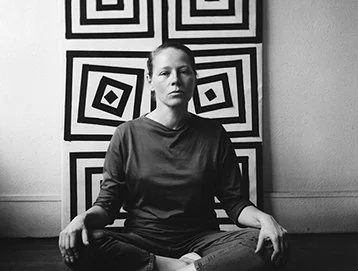
The process wall
In 1968, while student demonstrations mobilised the country, Vera Molnar gained what the Centre Pompidou's own magazine account of her career calls secret access to the computing centre at Orsay, the same year she began producing digital drawings from a computer connected to a plotter. The wall she then worked against was not a lack of drawing skill — she had painted geometric abstraction for two decades already — but a wish to test how far a rule could be pushed before it stopped looking like a rule.
What the documents show
The museum's exhibition page for her 2024 retrospective 'Parler à l'œil' ('Speak to the Eye', 28 February to 26 August 2024) describes a working method built on families of simple geometric forms, iterated and mutated across long series such as 'Déambulation entre ordre et chaos' (1975), which the museum says introduced 'a certain percentage of disorder' into otherwise regular compositions. The magazine account gives the figure Molnar herself used: '1% of disorder', a deliberate irregularity she injected to stop a strict system reading as sterile. Her holdings in the Museum of Modern Art's collection record her, more plainly, as a French artist born in Hungary in 1924 who died in 2023 — confirmation that the plotter period sat inside a seven-decade practice, not a brief experiment.
Authorship and limitation
The mechanism worth naming here is the difference between a rule and its execution. Molnar wrote the constraints — a family of squares, a permitted range of rotation, a stated proportion of deliberate error — and the plotter carried them out with a consistency her hand could not match and was never asked to. The '1%' is the tell: it is not randomness left uncontrolled, but a quantity she set herself. A machine that drew perfectly on every run would have produced a duller body of work than one instructed to fail by a fixed, small amount. Authorship, on this evidence, sat in the choice of how much disorder to allow, not in the disorder itself.
What survives
What a maker can take from this, editorially, is a template for evaluating any system that claims to add 'creative randomness': ask what the tolerance is, who set it, and whether it is disclosed as a number or hidden inside a slider marked 'more' or 'less'. Molnar's practice survives as a documented, quantified decision rather than a mood.
- Compare a stated disorder percentage against a generative tool's undisclosed 'creativity' or 'variation' setting.
- Read the Pompidou's account of 'Déambulation entre ordre et chaos' against the earlier hand-painted series it developed from.
- Ask whether a current tool's randomness is a fixed, reportable quantity or an opaque default.
Molnar kept adjusting that quantity for the rest of her life, including a 2022 work she titled with a doubled figure, '2% de désordre en coopération' — evidence the number itself stayed an active material, not a rule fixed once and left alone.
Sources & reading trail
States Molnar gained secret access to the Orsay computing centre in 1968 and describes her '1% of disorder' method and the 1974 Molnart program.
Source published: 28 November 2023 · Retrieved: 16 September 2026
Exhibition record describing 'Deambulation entre ordre et chaos' (1975) and 'a certain percentage of disorder' in her plotter compositions.
Source published: Not established · Retrieved: 16 September 2026
Collection record confirming Molnar as a French artist born in Hungary in 1924, with dates given as 1924-2023.
Source published: Not established · Retrieved: 16 September 2026
Papers, documentation, rulings and the makers' own records establish the note; the authorship reading and what-survives are Creative AI editorial analysis. This retrospective draft does not imply the site published on the event date.