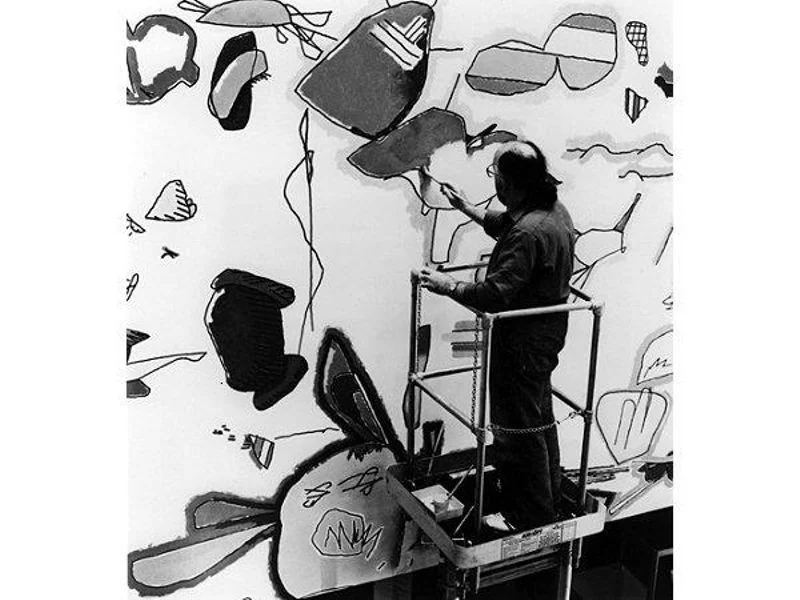
The process wall
Harold Cohen was an established painter representing Britain at the 1966 Venice Biennale when he set that practice aside to write a drawing program. According to the Computer History Museum's account, the system he began at the University of California, San Diego became AARON in 1973, a rule-based generator that composed line drawings and sent them to a robotic 'turtle' holding a pen. The wall Cohen met was not only technical: once a machine could compose a passable drawing, the question became what counted as his own work.
What the documents show
The Whitney Museum's exhibition record for 'Harold Cohen: AARON' (3 February to 19 May 2024) describes AARON as an early artificial-intelligence program for artmaking, conceived in the late 1960s and formally named in the early 1970s, and states Cohen built his own plotters and painting machines to turn the software's commands into physical marks. The Computer History Museum's account adds detail the exhibition summary omits: AARON's output stayed to monochrome line drawings that Cohen coloured by hand until 1995, when a new subsystem let the machine mix paint and apply it using a vacuum table and brushes it selected itself. The two records agree on the shape of the collaboration even where they foreground different decades of it.
Authorship and limitation
Cohen's own language, quoted in the museum's account, is the sharper evidence. He preferred to call AARON an 'expert's system' rather than an 'expert system', explaining that it served as 'a research tool for the expansion of my own expert knowledge rather than to encapsulate that knowledge for the use of others.' That is a specific claim, not a modest one: the program never operated as a stand-alone artist for hire. Cohen kept the rule design, the addition and removal of forms, and, for two decades, the colour. AARON kept the combinatorial work of composing each individual drawing from those rules. Asked about the program signing its own work, Cohen suggested that act alone would settle whether it was intelligent — a question he left open rather than answered himself.
What survives
What a maker can take from this is not a verdict on machine creativity but a working division of labour that predates today's prompting tools by half a century: rules are authored, arrangements within them are generated, and someone still decides which outputs earn a signature. Editorially, that division is worth applying to any current tool that claims to 'create': ask what was fixed in advance, what varied automatically, and who chose what to keep.
- Compare AARON's rule-based composition with a diffusion model's statistical one — both generate arrangements, from differently authored constraints.
- Read the Whitney's exhibition description against the museum's account of the 1995 colour system to see how sources can differ in emphasis without disagreeing on fact.
- Ask, of any generative tool, which decisions its maker fixed into rules beforehand and which the software supplies fresh each run.
Cohen died in April 2016 having spent over forty years revising one program's rules rather than replacing it; that duration of attention is itself part of the record.
Sources & reading trail
States AARON began in 1973 at UCSD, describes the 1995 addition of automated colour via a vacuum table, quotes Cohen's 1988 'expert's system' description, and records Cohen's death on 27 April 2016.
Source published: 23 August 2016 · Retrieved: 16 September 2026
States Cohen conceived the software in the late 1960s at UCSD and named it AARON in the early 1970s, and that Cohen built his own plotters and painting machines.
Source published: Not established · Retrieved: 16 September 2026
Papers, documentation, rulings and the makers' own records establish the note; the authorship reading and what-survives are Creative AI editorial analysis. This retrospective draft does not imply the site published on the event date.