The process wall
A photojournalist submitting to World Press Photo has to decide, before entering, which of the AI-adjacent tools already in Lightroom or Photoshop are permitted and which disqualify an entry outright. The contest's current entry rules, retrieved 16 September 2026, state the position without qualification: 'AI-generated images are not photography. A photograph captures light on a sensor or film, it is a record of a physical moment... All photographs entered into the contest must be made with a camera. No synthetic or artificially generated images are allowed, and no use of artificially generative fill is allowed in post-production.' That sentence is the wall: it fixes capture, not appearance, as the thing the contest is judging.
What the documents show
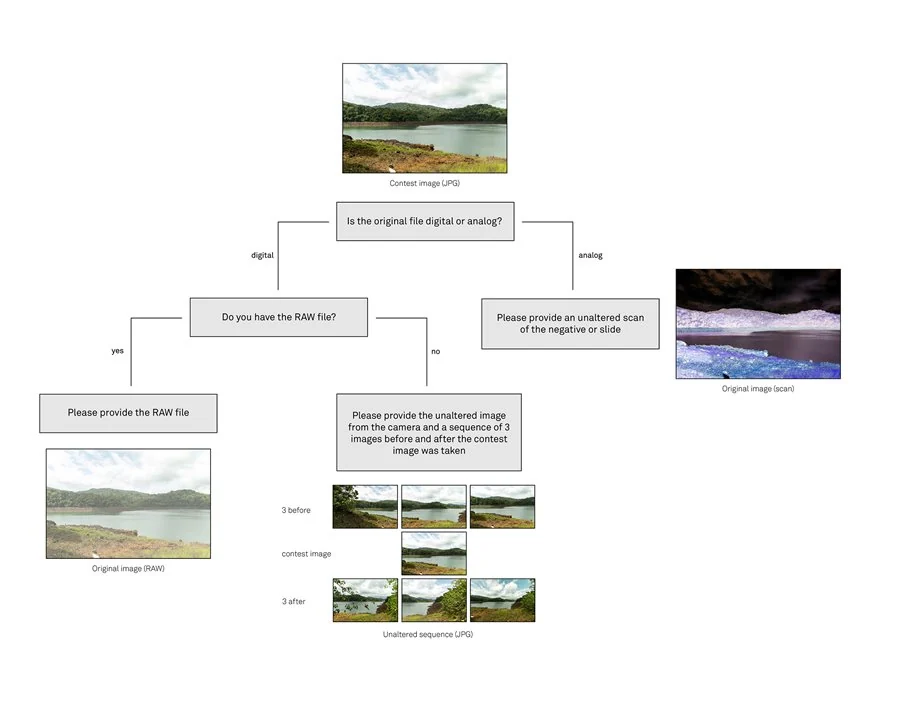
The same rules then draw a finer line inside what counts as editing. Smart or AI-powered enhancement tools remain usable 'as long as these tools do not lead to significant changes to the image as a whole, introduce new information to the image, nor remove information from the image that was captured by the camera', naming denoising, automatic levels and colour adjustment, and local object selection as still in bounds. Against that, the rules name specific disqualifying tools: 'AI powered enlarging tools such as Adobe Super Resolution and Topaz Photo AI', described as 'based on generative AI models that introduce new information to enlarge and sharpen images'. The contest's separate verification process states that entries reaching later rounds must supply camera-original files, a RAW frame or full-format JPEG, with three frames shot before and three after the entered image, to check compliance.
Authorship and limitation
The mechanism the rules name is information change, not tool category: a denoise pass removing sensor noise the camera introduced is treated differently from an upscaler that invents detail the sensor never captured, even though both use trained models. That is a workable, if contestable, technical line, and the rules put the burden of the underlying camera file on the photographer, since verification can request the surrounding frames of a submitted image at any later round. The rules describe this as continuous with 'rules on manipulation from previous years' rather than an entirely new position, though the specific AI-tool clauses are dated to the document as retrieved rather than to a single historical announcement.
What survives
What a documentary photographer can check against these rules, editorially, is whether a given tool's own documentation describes it as reconstructing or inventing pixel information, which is the rules' own test, rather than relying on a tool's marketing description of itself as an 'enhancement'.
- Read the contest's own 'what counts as manipulation' guidance referenced in its verification process.
- Check whether an editing tool's documentation describes it as adding, removing or only adjusting existing information.
- Keep the surrounding camera frames for any entered image, since verification can request a seven-frame sequence.
The rules do not ban computation from the darkroom; they ban computation that invents what the sensor did not record, and they put a camera-file audit behind that line rather than leaving it to a caption.
Sources & reading trail
States the current rule barring synthetic and generative-fill images and lists specific AI tools that automatically disqualify an entry.
Source published: Not established · Retrieved: 16 September 2026
States the camera-original file and multi-frame sequence entrants must supply to verify compliance with the manipulation rules.
Source published: Not established · Retrieved: 16 September 2026
Papers, documentation, rulings and the makers' own records establish the note; the authorship reading and what-survives are Creative AI editorial analysis. This retrospective draft does not imply the site published on the event date.